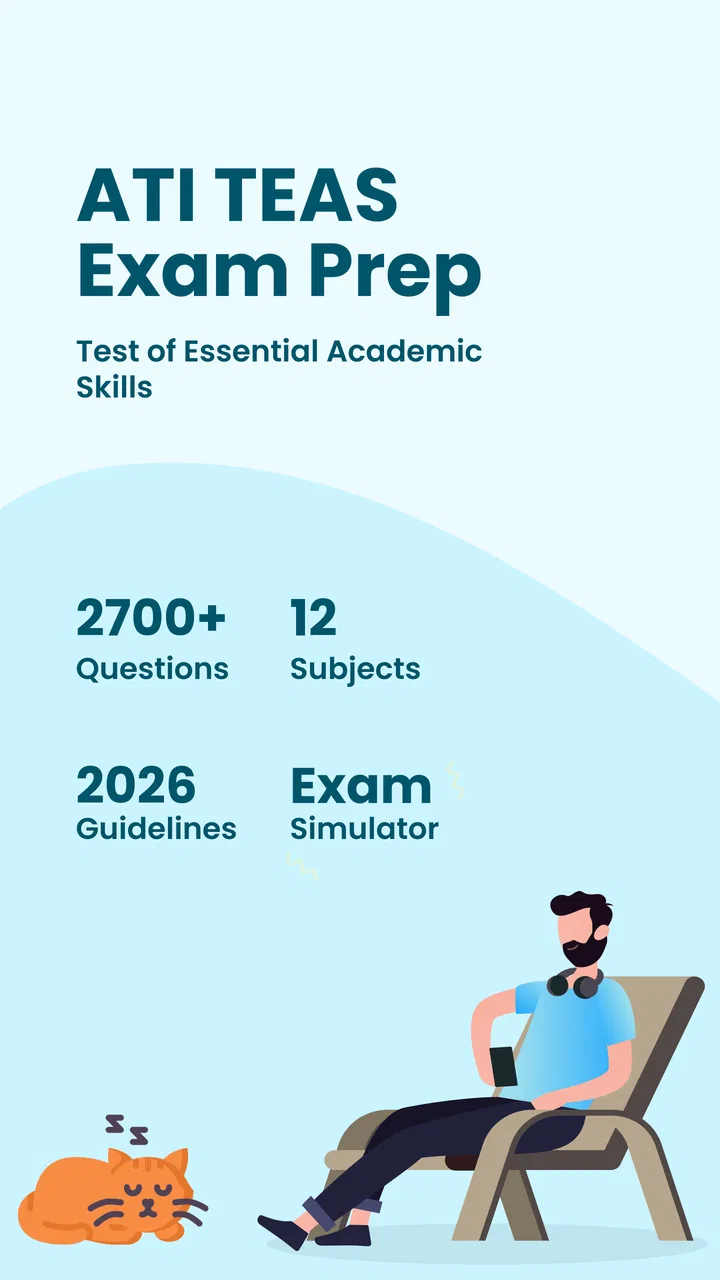
ATI TEAS Exam Prep 2026
- 4.7
- Rating
- 10.00K
- Installs
- Free
- Price

 Analysis by App-foxy
Preparing for the ATI TEAS can feel less like ordinary studying and more like managing a long list of small decisions: which subject to review, whether to take another practice test, how to use a short break, and when to stop collecting material and start checking what you actually understand. ATI TEAS Exam Prep 2026, developed by Prepia Inc, is built for that particular problem. It is an education app focused on nursing entrance-exam preparation, with a large bank of practice questions, tests, and study guides gathered into a phone-friendly format.
I found the app most useful when I treated it as a structured practice companion rather than a complete replacement for every other study resource. The attraction is obvious: instead of carrying separate books, notes, and question sheets, I could open one app and move directly into a study task. The less obvious question is how well that convenience holds up when the network is slow, when I am studying in a busy place, or when I only have a few minutes. Those details matter because exam preparation often happens in real-world gaps, not at a perfectly arranged desk.
The app is free to install and is rated for Everyone, which makes it approachable for a wide range of learners. Its average rating is 4.7 from more than 500 ratings, and it has passed 10K+ installs. The current version is 2.1.030, and it runs on Android 7.0 or later. Optional purchases range from $7.99 to $99.99 per item, so I would start by exploring the free experience carefully before deciding whether paid material fits my study plan.
You May Also Like

 Blood Strike: 2.5 Anniversary
Blood Strike’s Loadouts Turn Every Drop Into a Tactical Gamble
A close look at Blood Strike’s custom loadouts: how fast access to signature weapons reshapes its battle royale rhythm, rewards preparation, and narrows the gap between fights.

 Pandora - Music & Podcasts
Pandora’s Music Is Easy to Start, but Harder to Recover
Pandora’s strength is its low-effort path from a seed to a station. Its weak spot is how much confidence it asks you to place in connection, setup, and quiet recovery.

 8 Ball Pool
 Is Built on Rivalries, Rematches, and Routine
A close look at the rivalries, rematches, shared routines, and unanswered safety questions that turn a quick pool match into a persistent mobile community.

 Samsung Music
’s Quiet Strength Is Playing What You Already Own
Its reach comes less from spectacle than from dependable access to a personal library. That simplicity is both the app’s strongest retention engine and its ceiling.

 AccuWeather: Weather Radar
AccuWeather Review: A Quick, Clear Forecast for Everyday Decisions
For everyday plans, the best forecast is the one you can understand quickly. AccuWeather makes rain timing, radar, and local conditions easy to act on, with a few trade-offs.

 Hill Climb Racing
Why Hill Climb Racing Still Turns Crashes Into One More Run
A tiny car, a bumpy hill and one more upgrade: Hill Climb Racing keeps resurfacing because its simple chaos makes every near-miss feel personal.
More From Our News Desk
View All News


How connectivity changes the study experience
I find connectivity is easiest to manage when I plan around the kind of study session I want, rather than assuming every moment is suitable for a full test. A quick review can tolerate a little friction; a timed practice session deserves a stable setting and a backup plan. That distinction leads naturally to the next question: how to make short sessions useful without letting them become rushed or superficial.
Where the network becomes part of the routine
Because this is a mobile study app, connectivity can shape the experience even when the academic content is the main attraction. Opening a practice session, moving through questions, or accessing study material may feel effortless on a dependable connection, but the same routine can become less predictable in a crowded building, on public transport, or in a room with weak reception. I would not plan an important timed session around an uncertain signal. For serious practice, a stable connection and a few minutes of setup are sensible preparation.
This is especially important when a learner expects the app to behave like a paper workbook. A printed book is immediately available once it is in your bag. A phone app depends on the device, the app itself, and the connection conditions around you. That does not make the app a poor choice; it simply means that convenience is partly tied to the environment. I liked the flexibility of having preparation material on a phone, but I also learned not to confuse portability with guaranteed availability in every location.
A useful habit is to open the app before a planned study block rather than waiting until the exact moment you want to begin. That gives you time to confirm that the relevant section loads and that the phone is ready for a focused session. It also reduces the temptation to replace a planned twenty-minute review with random browsing while waiting for a page or test to become usable.
Short mobile sessions are where it makes the strongest case
The best use case for this app is the learner who has several small windows during the day. A bus ride, a lunch break, or the quiet period before an appointment can become a focused question session. I would use a short window for one subject area or a small review target rather than starting a full-length test with no confidence that I could finish it. That approach makes the phone format feel intentional instead of improvised.
For example, imagine a nursing student who has fifteen minutes before work. Opening the app, choosing a narrow topic, answering questions, and writing down one recurring mistake can produce a useful study loop without requiring a desk. Later, that same learner can return to the topic with more time and use a longer test to see whether the improvement holds. The important point is not simply answering more questions; it is turning each mobile session into a decision about what to do next.
The phone format also helps learners who become overwhelmed by large study books. A thick preparation guide can make the exam feel enormous before studying even begins. A question-based app gives a more immediate starting point. I could begin with a few questions, notice where my confidence was weak, and then choose a study guide instead of reading everything from the beginning. That is a practical advantage for people who need feedback before they can organize their time.
There is a trade-off, though. Mobile convenience can encourage shallow studying. Tapping through questions while distracted may create the feeling of progress without much retention. I would avoid using it while multitasking, especially during explanations or difficult reading. A phone is excellent for access, but it is also full of interruptions. Turning the study period into a deliberate block, even a short one, matters more here than the size of the question bank.
Using questions as a diagnostic tool
The most valuable way to approach the practice material is not to chase a high number of completed questions. I would divide mistakes into at least three groups: facts I had never learned, concepts I partly understood, and careless errors caused by rushing. Each group needs a different response. A missing fact calls for review, a weak concept calls for slower explanation and more examples, and a careless error calls for better pacing.
This workflow is more useful than simply repeating the same test until the score rises. If I answered a question correctly by guessing, I would still mark it as uncertain. Otherwise, the app could make my preparation look stronger than it really is. After a session, I would select a small set of uncertain topics and use the study-guide material to address them before attempting more questions.
Another practical tip is to keep a separate note outside the app for recurring errors. The note does not need to be elaborate. A short entry such as “misread the question,” “mixed up two terms,” or “forgot the process” is enough to reveal patterns over several sessions. This is particularly helpful when using a phone, because quick practice can otherwise become a series of disconnected attempts with no long-term record.
What happens when the connection is unreliable
Network problems are most frustrating when they interrupt concentration. If a question or test does not load smoothly, I would first stop tapping repeatedly. Repeated attempts can make it harder to tell whether the problem is temporary or whether the session has stalled. Checking the connection, closing and reopening the app, and returning to the same study goal in a calmer way is usually a better recovery process than abandoning the entire day.
I would also keep a simple backup plan. That might be a handwritten list of topics to review, a textbook chapter already available to me, or a small set of notes created during earlier sessions. This is not a claim that the app provides offline access; it is a sensible way to protect a study schedule when any online tool becomes unavailable. The app can remain the main practice tool while the backup prevents one connectivity problem from wasting a valuable study window.
Before a high-stakes practice session, I would avoid relying on a weak public network. A timed test is meant to show how I perform under pressure, not how patiently I can wait for content to load. A stable home connection or another dependable setting is the better choice. Short review sessions are more forgiving, but even then I would rather switch tasks than turn the session into a technical struggle.
Being careful with mobile data
Learners who have limited mobile data should treat long test sessions differently from quick reviews. I would use a trusted Wi-Fi connection when preparing for a substantial practice block, especially if the app needs to load several screens or study materials. On mobile data, I would favor short, targeted sessions and avoid opening material repeatedly without a clear objective.
This data-conscious approach also improves studying. Choosing a topic before opening the app prevents aimless navigation, while a written list of weak areas makes each connection more productive. If I have only a few minutes and limited data, I would review one difficult concept or complete a small question set rather than starting a broad session that I may not finish.
Battery planning belongs in the same conversation. A phone that is nearly empty is not a dependable study device, particularly if a connection problem leads to repeated reopening. I would charge before a longer test and keep the screen brightness and other phone activity sensible. These are ordinary precautions, but they make the difference between a convenient study tool and an unreliable one during a busy day.
How the app compares with books, videos, and formal preparation
Compared with a traditional TEAS preparation book, this app is easier to carry and better suited to quick retrieval. A book is often stronger for extended reading, annotation, and studying without depending on a phone. I would choose the app when I need practice access in changing locations, and a book when I want to sit down for a deeper explanation without notifications or a small screen.
Compared with video lessons, question practice is more active. Videos can be helpful when I need a concept explained from the beginning, but watching can become passive. The app asks me to make a choice and exposes uncertainty more quickly. On the other hand, if I repeatedly miss a topic because I do not understand the underlying lesson, more questions alone may not solve the problem. That is when a textbook, instructor, or carefully chosen lesson can be better.
Compared with a formal prep course, the app is more flexible and likely easier to fit around work or classes. A course may offer accountability, a fixed sequence, or personal guidance that a self-directed app cannot replace. I would recommend this app to someone who can diagnose weaknesses and maintain a schedule. I would be more cautious for a learner who needs another person to set deadlines, explain every difficult answer, or monitor progress closely.
Free access, paid decisions, and realistic expectations
The free price makes it reasonable to test the app before spending money. I would first check whether the available practice style matches the way I learn, whether the study guides are clear enough for my needs, and whether the app fits my daily routine. The presence of in-app purchases from $7.99 to $99.99 per item means the cost can vary considerably depending on what a learner chooses, so I would avoid buying simply because a larger package feels more reassuring.
A paid option is worthwhile only if it changes my preparation in a measurable way. For me, that would mean access to material I am actually using, a clearer study sequence, or enough additional practice to address a specific weakness. It would not be worthwhile as a substitute for a plan. Buying more content without reviewing mistakes can create a larger pile of unfinished material rather than better readiness.
The app should also be viewed as preparation support, not a promise of exam success. A large collection of questions is useful, but the quality of the study routine still depends on honesty, review, pacing, and coverage of the subjects that matter to the learner. I would combine it with the official expectations for the exam and with other explanations whenever the practice material reveals a gap in understanding.
Who should use it and who should look elsewhere
I think ATI TEAS Exam Prep 2026 is a good fit for a nursing applicant who wants practice questions close at hand, prefers learning by testing, and can create a personal schedule. It is also useful for someone returning to study after a long break, because a few questions can reveal which areas need attention before the learner commits to a full revision plan.
I would be less enthusiastic for someone who wants a complete classroom-style course inside one app, detailed personal feedback, or a guaranteed distraction-free experience. It is also not the right sole resource for a learner who has major gaps in foundational science or reading skills and needs extensive teaching before practice becomes productive. In those cases, an instructor, textbook, or broader course should carry more of the workload, with this app used as a practice layer.
My final view is positive but practical. The app is strongest when I use it as a focused diagnostic and practice tool, not as an automatic study plan. Its mobile format makes it easy to turn spare minutes into deliberate revision, while the question-and-test approach encourages active recall instead of passive reading. Connectivity is part of the experience, so I would prepare longer sessions on a reliable network, keep a backup for interruptions, and be mindful of mobile data.
Prepia Inc has made a useful option for learners who want TEAS preparation in a compact education app. The free entry point lowers the risk of trying it, the Everyone age rating keeps it broadly accessible, and the current version supports a modern Android setup beginning with Android 7.0. I would recommend starting small, tracking mistakes outside the app, and paying only when a specific need justifies it. Used that way, ATI TEAS Exam Prep 2026 can become a dependable part of a nursing-exam routine without pretending to replace every other form of preparation.
FAQs for ATI TEAS Exam Prep 2026
01What is ATI TEAS Exam Prep 2026, and who is it designed for?
ATI TEAS Exam Prep 2026 is a study app intended for students preparing to take the Test of Essential Academic Skills, commonly required for admission to nursing and other healthcare programs. It typically covers Reading, Mathematics, Science, and English and Language Usage. The app is most useful for learners who want mobile practice, topic reviews, and a structured way to identify weak areas before test day.
02Does ATI TEAS Exam Prep 2026 include realistic practice questions and full-length tests?
The app is designed around TEAS-style preparation and generally provides practice questions across the exam’s main sections, along with explanations or review material to help users understand mistakes. Depending on the version and subscription, it may also offer timed quizzes or simulated exams. Before downloading, check the current listing to confirm the exact number of questions, tests, explanations, and included features.
03Can I use ATI TEAS Exam Prep 2026 without an internet connection?
Offline access depends on how the app delivers its lessons, question banks, and progress data. Some study content may be available after it has been downloaded, while account features, advertisements, synchronization, or premium materials may still require an internet connection. If you plan to study during commuting or in areas with limited service, review the app’s offline requirements and test the feature before relying on it.
04Is ATI TEAS Exam Prep 2026 free, or does it require a subscription?
The application may be available to download at no initial cost while offering premium content through in-app purchases or a subscription. Free access can be limited to selected questions, sections, or basic progress tracking, whereas paid plans may unlock the complete question bank, detailed explanations, mock exams, and advanced analytics. Always review the current pricing, renewal terms, and cancellation policy in your app store.
05Can ATI TEAS Exam Prep 2026 guarantee a passing score on the TEAS exam?
No study app can guarantee a passing score because results depend on your existing knowledge, study consistency, test-taking skills, and the specific requirements of your nursing program. ATI TEAS Exam Prep 2026 can support preparation by providing practice and highlighting weaker subjects, but it should be combined with official TEAS information, a realistic study schedule, and additional resources when necessary. Confirm exam rules and scoring details through official sources.
Pros
- Covers core TEAS subjects in one focused study app.
- Practice questions help build familiarity with the exam format.
- Useful for reviewing concepts during short study sessions.
- Progress tracking can help identify areas needing more attention.
- Convenient alternative to carrying printed study materials.
Cons
- Some advanced features may require a paid subscription.
- Content quality may vary between subjects or question sets.
- Practice scores may not perfectly predict official TEAS results.
- Requires consistent self-study and offers limited personal guidance.
- Ads or upgrade prompts may interrupt studying in the free version.

ATI TEAS Exam Prep 2026
Gallery